
This section outlines the low-impact food production systems we have adopted. They are designed to have a net-positive benefit on this ecosystem, and the environment more generally.
If you have questions or want more information, please get in touch. You should be confident in knowing how your food is produced.
We try to minimize any inputs that require production and transportation, and instead design systems based on the resources we have on site. By doing so, we can avoid the unnecessary consumption of energy for transport, and we can ensure that our resources are sourced in a way that does not harm other people, animals, or the planet.
Even relying on “renewable” or “natural” resources brought from elsewhere can be problematic. Such resources can derive from the exploitation of another place for our benefit or convenience, such as buying lumber sourced from a clear-cut forest or relying on peat moss as a component of our soil mix for seedlings. In cases where we need to purchase products from elsewhere, we do our best to find local, sustainable sources, to support local economies and move toward a more circular economic pattern. But we constantly seek alternatives: when possible we use logs from our property for building projects rather than purchased lumber, and we are presently testing out alternatives to using peat moss, such as making our own leafmould.
Even more problematic than such naturally-derived products are plastics and other materials that are produced, purchased, transported, and in the end cannot be cycled into nutrients. Some plastic materials can't even be recycled if they are too contaminated with soil, etc.
We’ve designed systems that avoid a dependence on these sorts of products as much as possible:
- We NEVER use single-use plastic mulch. We mulch with leaves and wood chips.
- We minimize the need for irrigation equipment with the use of mulch and hügelkultur (see below). The equipment we do buy is designed to last decades, not a season or two.
At the end of each season we will perform a voluntary inputs audit that details what external products we needed to purchase and the amount of fossil fuels we consumed through our farming activities. This provides transparency for concerned customers and helps us find ways to improve over time.
There are some exceptions we’ve made to these ideals.
We did purchase a small plastic-wrapped greenhouse (16’x30’) for starting seedlings, propagating perennials, etc. Yes, that is a playpen in the greenhouse.
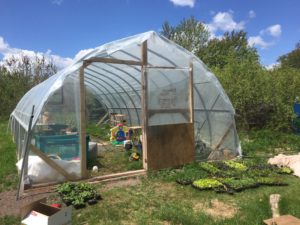 Over the coming decade we will source repurposable materials for a “northern greenhouse” project, and will likely purchase a small plastic-wrapped hoop house as well.
We will use heavy silage tarps, which have a long useful life. By covering a garden plot with a silage tarp for a few weeks, dormant weed seeds quickly germinate and die prior to planting the desired crops, greatly reducing subsequent weed pressure.
Tarps can also be used to kill the sod when opening up a new garden plot. Instead of turning over the sod with a plow, the little critters in the soil happily break it down for us.
We are experimenting with the use of row covers, which provide physical barriers to protect young plants from six-legged opportunists. Unfortunately, row cover is easily torn, has very poor longevity, and thus will be used minimally.
There are other non-renewable products that we do rely on as well, such as the ever-versatile 5 gallon bucket. At least they are recyclable at the end of their life.
We always seek alternatives, but rely on non-renewable inputs only when they are of particular benefit with no viable alternative. Instead of taking for granted that we should purchase a product that benefits us, we consider the impact of a product’s entire life-cycle when deciding whether it is justified.
In place of energy-intensive external inputs, we develop nearly closed-loop farm systems that mimic the nutrient cycling observable in nature.
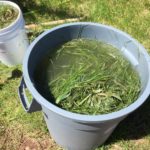
Tea made from weeds and grass clippings
We produce our own compost and compost teas to increase fertility in the gardens. No chemical fertilizers, no compost transported from elsewhere. Our chickens are the stars in this department, as their high-nitrogen manure balances the otherwise high-carbon materials we depend on.
On most of our garden beds, we use a thick mulch. The mulch is comprised of (1) leaves and other rotting debris we collect from the forested parts of our property, (2) ramial wood chips that we chip on site, and (3) some old straw, grasses, and other materials collected from our property.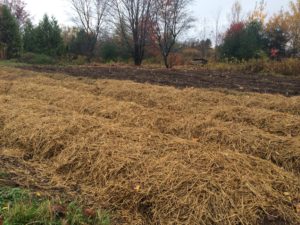
This deep mulch retains moisture in the soil, slowly breaks down into humus, promotes mychorrizal growth, sustains diverse biological activity, prevents soil erosion, and inhibits weed growth. Ultimately it mimics the processes that take place on a forest floor.
We are experimenting with hügelkultur on three garden plots over the next few years. If it proves successful, we will expand the number of areas where we take this approach. We collect mostly rotting wood from the forest, bury it in the ground along with compost, and cover it with mulch.
The buried rotting wood holds water like a sponge, keeps the soil aerated, slowly releases nutrients, houses lots of critters, and even warms the soil as it decomposes.
Both the thick mulch and hügelkultur are part of strategy to minimize water consumption and be resilient in the face of drought. Presently our water source for home and farm is a dug well, so the need to conserve water is motivated both by physical limitations and our farming philosophy. Rainwater collection will be a project for 2019.
We practice no-till farming, which keeps carbon in the soil and out of the air, preserves the soil structure, and encourages the proliferation of biological activity. After forming raised beds (and/or loading trenches with rotting wood for hügelkultur), we cover the bare soil with a mulch, add to the mulch as needed, and leave the soil undisturbed indefinitely.
In each of our garden plots we practice companion planting by grouping plants that have symbiotic benefits when planted together. We rotate these groups of plants together to new garden plots each year.
Our chickens are also a part of the rotation. The coop is set up beside garden plots on which (for that particular year) we don't grow any vegetables, although we plant things for the chickens to eat. They peck and scratch the mulch and enrich the soil for crops the following year. The chickens are cherished members of our little operation. The rich compost they produce is immensely valuable, and they’re pretty good at turning sod into a new garden bed, too. We're working toward acquiring a variety of heritage breeds, particularly those that are good foragers.
We leave wild spaces around many of our garden plots and we design habitable spaces to welcome more beneficial wildlife into the neighbourhood.
Between the annual garden plots we are establishing rows of edible perennials, flowers to attract pollinators, and wild edibles.
We NEVER use commercial insecticides, fungicides, or herbicides. Our approach to pest control is more preventative than reactive. By interplanting, companion planting, growing on small plots, maintaining habitats for predator insects, and following a planned rotation of our crops, we establish an environment which makes it difficult for problematic insect populations to get out of control. These measures also mitigate the spread of certain plant diseases. We use row cover as a physical barrier for only a couple of crops, and we may experiment with making our own repellent sprays with garlic, chili, mint, etc.
Like many market farms, the bulk of our work is done with hand tools. We see primary reliance on human power as a crucial way to challenge the fuel-intensive society we live in.
Hand tools are better considered timeless and valuable technologies rather than relics of a past era. Spending time working on the land also allows more time to observe and closely monitor what is happening with our plants, soil, animals, etc.
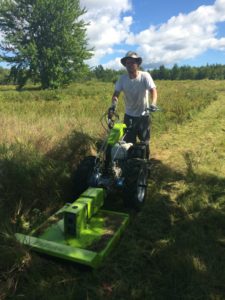 Our only fuel-dependent machine (other than a chainsaw) is a Grillo walk-behind tractor. It burns a small amount of fuel compared to a larger machine, and can power many different implements (via a tractor-like PTO).
With this relatively simple machine and only a single engine to maintain, we are able to mow pathways, plow and shape raised garden beds, produce wood chips, and shred materials for an efficient hot compost. Naturally, it has limitations compared to a larger tractor, but it is a lower-impact approach that more than meets our needs.
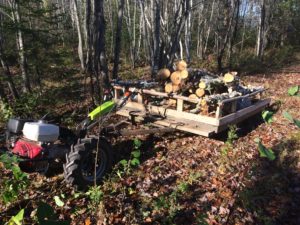 We also adapted an old trailer to attach to the walk-behind tractor, making it our primary method of transporting things around the property. (So what if it looks ridiculous?!) This simple setup allows us to avoid (or at least defer) buying a truck or trailer, and burns a fraction of the fuel a truck would.
We hope the energy invested in this land results in a more complex and interconnected ecosystem, which in turn becomes more resilient and productive. Reciprocity defines our relationship to the land. As time permits, we will engage in a number of projects that will help realize this goal over the coming years and decades.
- We will continue introducing new perennials and propagating wild ones that are already here, with the intent of establishing a forest garden.
- In our already-forested areas, we want to cultivate crops that grow well under a forest canopy, and encourage the growth of beneficial wild species.
- We are interested in developing a self-seeding garden.
- We will continue propagating and cultivating some of the traditional sources of food and medicines of eastern North America.
- We are experimenting with growing annual crops in a living mulch, such as white clover.
Check out our Points of Irrelevance page for some thoughts on why farming on a small scale is an important way forward for North American society.